Reishi for Sleep: The Science of How It Calms the Body
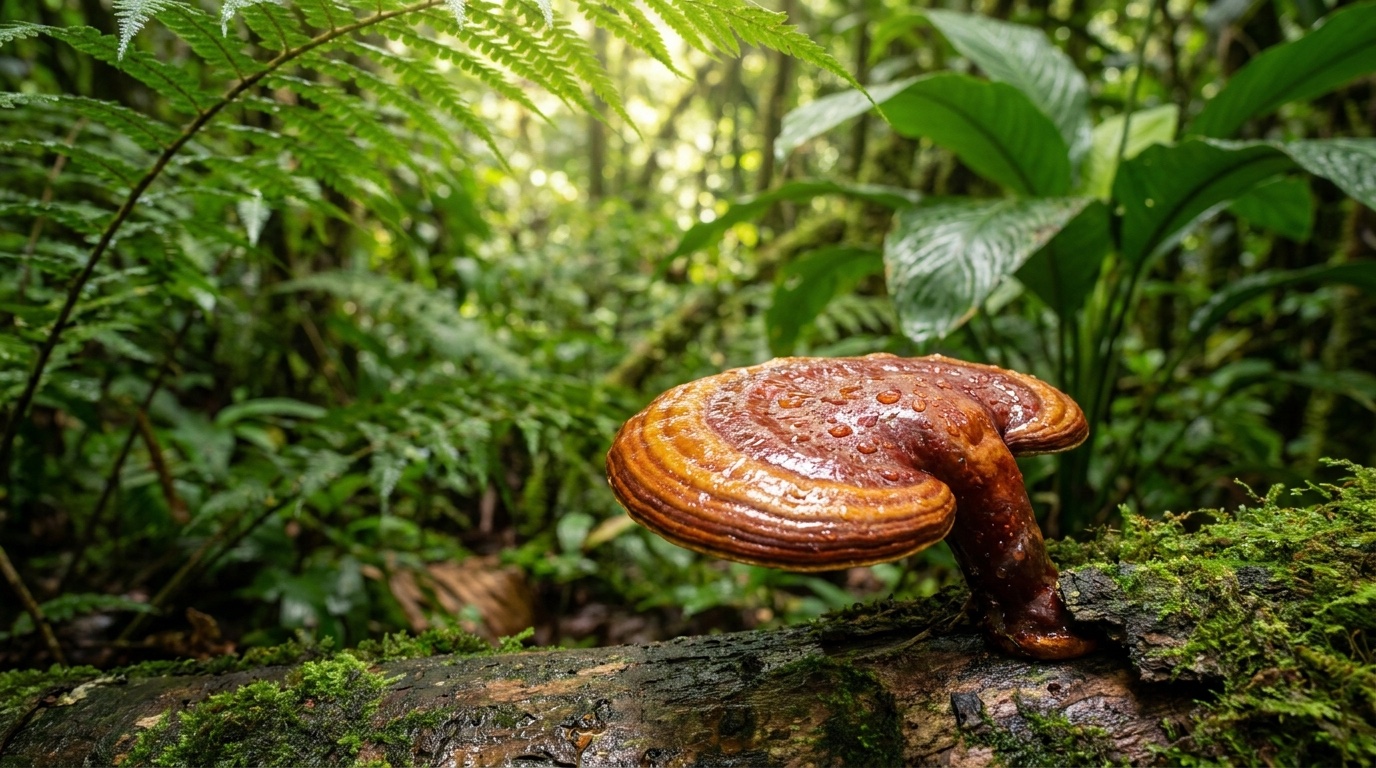
Most "reishi for sleep" articles tell you it works and leave it there. That's not very satisfying — and it isn't quite true either. Reishi (Ganoderma lucidum) is not a sedative. It won't knock you out the way a sleeping pill does, and the research is surprisingly clear on that point.
What the science actually describes is subtler and, frankly, more interesting: reishi appears to lower the body's resistance to sleep rather than force it. It's the difference between a switch and a dimmer. Below is an honest walk through what researchers have found, where the evidence is strong, where it's still early, and how to fold reishi into an evening wind-down in a way that respects what the studies actually show.
A 2,000-year-old reputation for calm
In traditional Chinese medicine, reishi — língzhī, the "mushroom of immortality" — was classified as a shen (spirit) tonic: a remedy taken not for a fast effect but to settle the mind over time. Ancient pharmacopoeias recommended it for restlessness, palpitations and insomnia. That historical use is why modern scientists started pointing sleep-lab equipment at it. Tradition is a hypothesis, not evidence — so let's look at the evidence.
What happens in a sleep lab: the animal studies
The most direct sleep research on reishi has been done in rodents wired for EEG, where investigators can measure exactly how much an animal sleeps and which sleep stages change.
Reishi extended total and deep (non-REM) sleep — but only modestly. In a 2012 study in the Journal of Ethnopharmacology, Cui and colleagues gave rats an oral Ganoderma lucidum extract (80 mg/kg) for three days and recorded their sleep. Total sleep time and non-REM (deep, restorative) sleep both increased significantly, while REM sleep and slow-wave patterns were left essentially untouched.1 Notably, the effect tracked with TNF-α, an immune-signalling molecule that is one of the body's natural sleep regulators — when the researchers blocked TNF-α in the brain, much of reishi's sleep-promoting effect disappeared.1 In other words, reishi seemed to be working through the body's own sleep machinery, not overriding it.
It behaved like a gentle GABA modulator — not a sedative. This is the single most important and most overlooked finding. In a 2007 study in Pharmacology, Biochemistry and Behavior, Chu and colleagues found that a reishi extract had no effect on normal, undisturbed rats at all. It only did something once the animals had already been given a low dose of a sleep-inducing drug — at which point reishi shortened the time to fall asleep and lengthened light and non-REM sleep.2 Critically, the effect was abolished by flumazenil, the same antagonist that reverses benzodiazepine drugs like diazepam.2 That points to a mild action on the GABAergic system — the brain's main "calm down" channel — but one that only expresses itself when the body is already moving toward sleep. A dimmer, not a switch.
A newer angle: the gut–serotonin pathway. In 2021, Yao and colleagues reported in Scientific Reports that a reishi mycelium extract dose-dependently lengthened sleep in mice and raised serotonin (5-HT) in the hypothalamus. The twist: when they wiped out the animals' gut bacteria with antibiotics, the sleep benefit vanished entirely.3 The effect depended on reishi enriching beneficial gut microbes (Bifidobacterium), which in turn supported serotonin signalling — a reminder that "a mushroom for sleep" may be acting partly through the gut, days into use rather than minutes.
The honest caveat: all three of these are animal studies. They tell us how reishi plausibly works and that the effect is real in a controlled model — but they are not proof of a given result in a human on a given night. Anyone who tells you a mushroom is a clinically proven sleep cure is getting ahead of the data.
Why "not a sedative" is the whole point
Put the studies together and a consistent picture emerges. Reishi does little to a calm, regulated nervous system (Chu 2007). It nudges the body's own sleep signals — TNF-α, GABA tone, gut-derived serotonin — rather than chemically sedating the brain.123
That's why reishi belongs in a wind-down ritual rather than a medicine cabinet. It isn't competing with melatonin or a prescription hypnotic to flip you unconscious. It's doing something closer to lowering the temperature in the room: making the conditions for sleep a little more available, gradually, with repeated use. For people who don't want a knockout drug but do want to feel less wired at 10pm, that profile is the appeal — not a bug.
Stress, anxiety and the cortisol question
A calmer evening is partly an anxiety story, and there is animal evidence here too.
In a 2016 study in the International Journal of Medicinal Mushrooms, a G. lucidum extract increased the time mice spent in the open arms of an elevated plus maze — a standard anxiety test — to a degree comparable with diazepam.4 And in a 2022 Nutrients paper, purified reishi triterpenoids reduced anxiety- and depression-like behaviour in mice exposed to early-life stress, alongside lower inflammatory cytokines (TNF-α, IL-1β, IL-6) in both blood and brain.5 The mechanism there was anti-inflammatory, not hormonal.
A note on cortisol, because honesty matters: reishi is widely marketed as a cortisol-lowering "adaptogen," but we couldn't find a single clean human study showing reishi lowers cortisol via the stress (HPA) axis. We're not going to cite one that doesn't exist. The defensible statement is narrower and still meaningful: in animal models, reishi shows anxiety-reducing and anti-inflammatory effects.45 If anyone shows you a "reishi lowers your cortisol" graphic, ask them for the trial.
The strongest evidence is about fatigue and wellbeing — and it's in humans
Here is where the data graduates from animals to people. The most robust human trials on reishi aren't about sleep onset at all — they're about daytime fatigue and sense of wellbeing, which is arguably what poor sleep costs you anyway.
The neurasthenia trial. In a randomised, double-blind, placebo-controlled study published in the Journal of Medicinal Food (2005), 132 people with neurasthenia (a condition of persistent fatigue and irritability) took a reishi polysaccharide extract for eight weeks. Versus placebo, the reishi group reported a significantly larger drop in fatigue and a greater rise in sense of wellbeing, and more than twice as many were rated meaningfully improved (51.6% vs 24.6%).6
Cancer-related fatigue. A 2012 pilot trial in Evidence-Based Complementary and Alternative Medicine gave reishi spore powder to breast-cancer patients with cancer-related fatigue for four weeks. The treatment group reported significantly less fatigue, less anxiety and depression, better quality of life, and showed lower inflammatory markers (TNF-α, IL-6) — with no serious side effects.7
Both trials are small and early-phase, and both used concentrated extracts rather than a hot drink. But they are real, randomised, human data pointing the same direction the animal mechanism studies do: less fatigue, a steadier mood, a calmer baseline.
How to actually use reishi in the evening
What the research implies for a real routine:
- Think consistency, not a single dose. The benefits in the studies came from days to weeks of use (the gut-serotonin effect literally requires the microbiome to shift). Reishi is a nightly habit, not a rescue remedy.
- Take it in the wind-down window, not at lights-out. Because it's a modulator rather than a knockout, the value is in signalling to your body that the day is closing — pairing it with the same cup, the same hour, the same dimmed lights. The ritual is part of the mechanism.
- Warm and bitter pairs naturally with cacao. Reishi's active triterpenes are intensely bitter; a warm cacao base both carries them pleasantly and adds its own gentle, comforting context. (This is exactly why we built our Reishi Evening Cacao the way we did — a single-origin reishi extract folded into real cacao, made to be the last warm thing you drink before bed.)
- Mind the caffeine. A reishi coffee is working against itself at night. For evenings, a caffeine-free cacao or tea base is the sensible carrier.
Safety and the honest bottom line
Reishi is generally well tolerated; reported side effects are usually mild (dry mouth, upset stomach). It can interact with blood-thinning and blood-pressure medication, and rare case reports have linked concentrated reishi powder to liver issues — so if you're pregnant, on medication, or have a health condition, talk to your doctor first.
The honest summary: reishi is not a sleeping pill, and the best human evidence is about fatigue and wellbeing rather than guaranteed deeper sleep. What the science supports is a gentle, GABA- and gut-mediated nudge toward calm, best experienced as a consistent evening ritual rather than a fast fix. If that's what you're looking for — a way to take the edge off the end of the day — reishi has both two thousand years of tradition and a genuinely interesting (if still young) body of research behind it.
These statements have not been evaluated by the Food and Drug Administration. This product is not intended to diagnose, treat, cure, or prevent any disease. This article is for educational purposes and is not medical advice.
References
-
Cui XY, Cui SY, Zhang J, et al. Extract of Ganoderma lucidum prolongs sleep time in rats. Journal of Ethnopharmacology. 2012;139(3):796–800. PMID: 22207209. doi:10.1016/j.jep.2011.12.020 — Animal study. ↩ ↩2 ↩3
-
Chu QP, Wang LE, Cui XY, et al. Extract of Ganoderma lucidum potentiates pentobarbital-induced sleep via a GABAergic mechanism. Pharmacology, Biochemistry and Behavior. 2007;86(4):693–698. PMID: 17383716. doi:10.1016/j.pbb.2007.02.015 — Animal study. ↩ ↩2 ↩3
-
Yao C, Wang Z, Jiang H, et al. Ganoderma lucidum promotes sleep through a gut microbiota-dependent and serotonin-involved pathway in mice. Scientific Reports. 2021;11:13660. PMID: 34211003. doi:10.1038/s41598-021-92913-6 — Animal study. ↩ ↩2
-
Singh R, Dhingra GS, Shri R. Evaluation of antianxiety potential of four Ganoderma (Agaricomycetes) species from India in mice. International Journal of Medicinal Mushrooms. 2016;18(11):991–998. PMID: 28008811. doi:10.1615/IntJMedMushrooms.v18.i11.40 — Animal study. ↩ ↩2
-
Mi X, Zeng GR, Liu JQ, et al. Ganoderma lucidum triterpenoids improve maternal separation-induced anxiety- and depression-like behaviors in mice by mitigating inflammation. Nutrients. 2022;14(11):2268. PMID: 35684068. doi:10.3390/nu14112268 — Animal study. ↩ ↩2
-
Tang W, Gao Y, Chen G, et al. A randomized, double-blind and placebo-controlled study of a Ganoderma lucidum polysaccharide extract in neurasthenia. Journal of Medicinal Food. 2005;8(1):53–58. PMID: 15857210. doi:10.1089/jmf.2005.8.53 — Human randomized controlled trial. ↩
-
Zhao H, Zhang Q, Zhao L, et al. Spore powder of Ganoderma lucidum improves cancer-related fatigue in breast cancer patients undergoing endocrine therapy: a pilot clinical trial. Evidence-Based Complementary and Alternative Medicine. 2012;2012:809614. PMID: 22203880. doi:10.1155/2012/809614 — Human randomized pilot trial. ↩