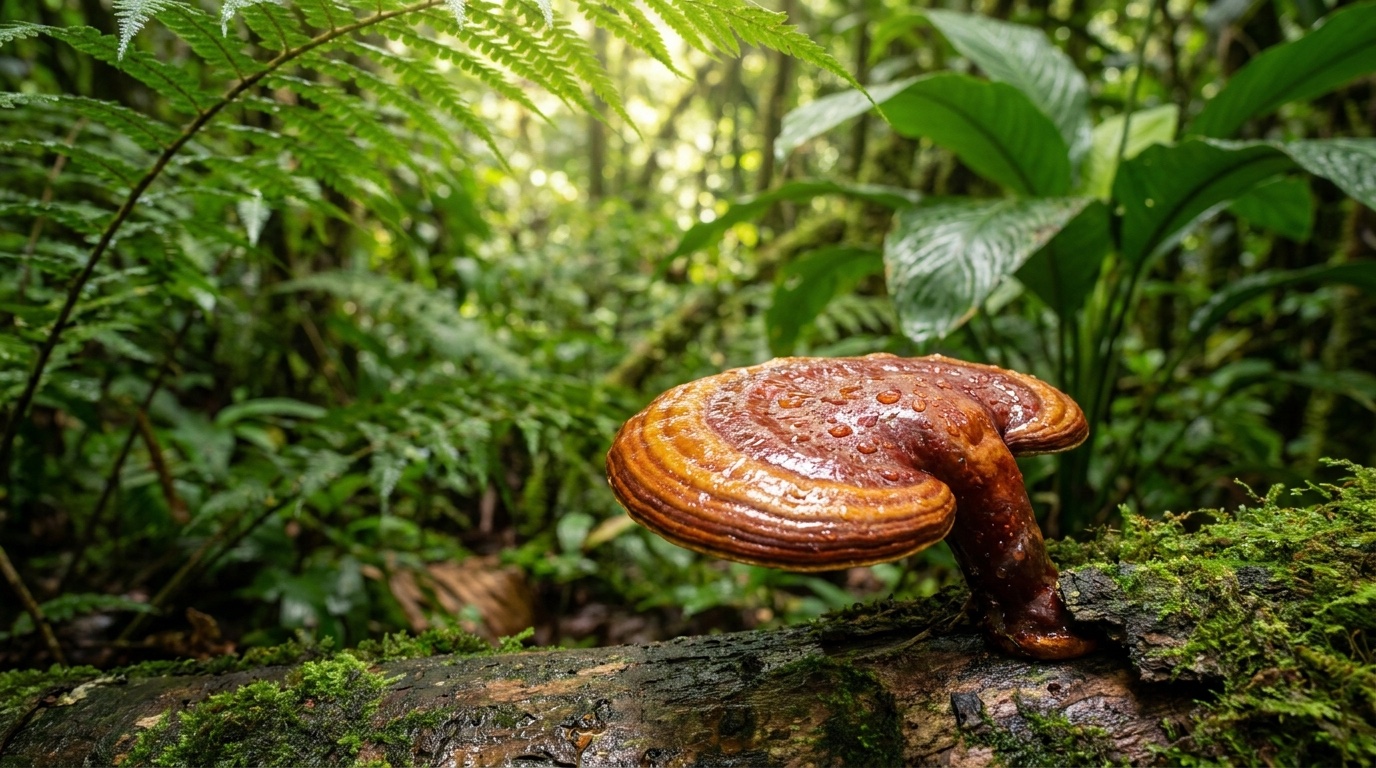
Reishi Mushroom Benefits: What the Science Actually Says
Search "reishi benefits" and you'll get a dozen near-identical listicles promising the same six or seven miracles: immunity, anti-cancer, better sleep, lower blood pressure, glowing skin. Almost none of them tell you which of those claims is backed by a human trial, which rests on a study in mice, and which is still just a cell in a dish.
This article does. Below is an honest, evidence-graded tour of what Ganoderma lucidum — reishi, or língzhī — has actually been shown to do, with every claim tied to a real, citable study. Some of the science is genuinely promising. Some of the most-repeated claims are, on close reading, not well supported at all. We think you deserve to know the difference before you spend money on a mushroom.
What reishi actually is (and what's in it)
Reishi is a hard, bitter, woody bracket fungus that has been used in East Asian medicine for over two thousand years — long enough to earn the name "mushroom of immortality." You don't eat it like a portobello; it's too tough and bitter. It's consumed as a tea, a powder, or — better — a concentrated extract.
Its reputation comes down to chemistry. A 2025 review in Antioxidants catalogues the active compounds in detail:1
- Polysaccharides (β-glucans) — roughly 26–28% of the dried fruiting body, built on a β-1,3-glucan backbone. These are the main drivers of reishi's effects on the immune system.1
- Triterpenoids (ganoderic acids) — more than 380 distinct lanostane-type triterpenes have been identified. These bitter compounds are linked to reishi's anti-inflammatory and liver-related activity.1
- Ling Zhi-8 (LZ-8), an immunomodulatory protein; ergosterol (a vitamin-D2 precursor); plus phenolics, fatty acids and trace minerals.1
The foundational scientific reference text on reishi — the Herbal Medicine chapter by Wachtel-Galor and colleagues — makes the crucial honest point up front: "most studies have been performed on animals or in cell-culture models, and human experimental studies have often been small, and the results are not always supportive of the in vitro findings."2 Keep that in mind as we go.
How to read the evidence
To keep this honest, each benefit below is graded by the kind of evidence behind it:
- 🟢 Human-trial evidence — tested in people, ideally randomised and placebo-controlled.
- 🟡 Early/mixed human evidence — small, uncontrolled, or conflicting trials.
- 🔵 Preclinical only — animal or test-tube studies; promising mechanism, unproven in people.
1. Immune modulation 🟡 (strong mechanism, mixed human results)
This is reishi's best-understood effect. Its β-glucans are recognised by receptors on immune cells — Dectin-1 and Toll-like receptors (TLRs) — which switches on macrophages and influences natural killer (NK) cells and cytokine signalling.1 A 2011 immunology review documents reishi polysaccharides acting on B-cells, T-cells, dendritic cells, macrophages and NK cells, while cautioning that "many questions still need to be answered" before reishi can be accepted as a proven anti-tumour agent.3
The human picture is genuinely mixed, and we won't pretend otherwise. In a 2003 study of advanced-cancer patients, a reishi polysaccharide extract raised average NK-cell activity from 26.6% to 34.5% and shifted several cytokines favourably — but it was an uncontrolled, open-label study.4 A larger 2005 trial in advanced lung-cancer patients, using a higher dose, found no significant change in immune markers across the group as a whole.5 Two studies from overlapping researchers, pointing in different directions. The mechanism is real; the consistent human benefit is not yet established.
2. Calm, sleep and fatigue 🟡 (the best human data is about fatigue)
Reishi's traditional reputation is as a calming shen tonic, and this is where some of the more convincing human data sits — though not where you'd expect.
Reishi is not a sedative. In rodent studies it doesn't knock down a normal, calm nervous system; it gently potentiates the body's own sleep signals through a GABA-related, benzodiazepine-like pathway and, in newer work, a gut-microbiome-and-serotonin route.6 But the strongest human evidence is about daytime energy, not sleep onset: in a randomised, double-blind, placebo-controlled trial of 132 people with neurasthenia (chronic fatigue and irritability), eight weeks of a reishi polysaccharide extract produced significantly greater reductions in fatigue and greater gains in sense of wellbeing than placebo.7
We've written a full, separate deep-dive on this — Reishi for Sleep: The Science of How It Calms the Body — because it's the most interesting and most misrepresented part of the reishi story.
3. A possible adjunct in cancer care 🟡 (not a treatment — read this carefully)
This is the claim most abused by marketers, so here is the careful version. The most authoritative assessment is a 2016 Cochrane systematic review (5 randomised trials, 373 participants). Its conclusion: the review "did not find sufficient evidence to justify the use of G. lucidum as a first-line treatment for cancer."8 When reishi was used alongside conventional chemotherapy or radiotherapy, patients were somewhat more likely to respond to treatment (relative risk 1.50) — but that result was not statistically conclusive (95% confidence interval 0.90–2.51, which crosses 1), and the reviewers flagged the trials' methodological weaknesses.8
In plain English: reishi is not a cancer treatment, and nobody should use it as one. There is a weak, unproven signal that it may help conventional treatment work slightly better and improve quality of life. That's an interesting research question, not a reason to skip oncology.
4. Heart and metabolic health 🟡→🔵 (largely unproven in humans)
Here the listicles get well ahead of the data. A 2015 Cochrane review looked specifically at reishi for cardiovascular risk factors (5 trials, ~400 participants, mostly people with type 2 diabetes). Its verdict was blunt: "evidence from existing randomised and controlled trials does not support the use of G. lucidum for treatment of cardiovascular risk factors."9 The measured effects on HbA1c, total cholesterol and LDL were essentially zero.9
A well-designed 2012 human crossover trial reached much the same place — no significant effect on cholesterol, blood pressure or antioxidant status — with one intriguing exception: it found lower fasting insulin and improved insulin sensitivity (HOMA-IR) on reishi, hinting at a mild effect on glucose handling worth further study.10 So: the blanket "reishi lowers cholesterol and blood pressure" claim is not supported by the best human evidence, while a small antidiabetic signal remains an open question.
5. Antioxidant and liver support 🔵 (promising, but preclinical)
Reishi triterpenes and polysaccharides are reliably antioxidant in the lab, and in animal models reishi reduces lipid peroxidation, raises the body's own antioxidant enzymes (SOD, catalase, glutathione peroxidase) and improves markers of fatty-liver disease.1 These mechanisms are real and consistent — but they are, so far, in test tubes and animals. There is no robust human randomised trial demonstrating clinical liver protection in people. Treat "reishi detoxes your liver" as an unproven extrapolation, not a fact.
The honest scorecard
| Claimed benefit | Best evidence | Honest grade |
|---|---|---|
| Immune modulation | β-glucan→Dectin-1/TLR mechanism solid; human trials conflict | 🟡 Mechanism strong, human mixed |
| Less fatigue / better wellbeing | Placebo-controlled human RCT (neurasthenia) | 🟢🟡 Best human data, but limited |
| Gentle, sleep-supportive calm | Animal mechanism (GABA, gut-serotonin) | 🔵 Promising, mostly preclinical |
| Cancer adjunct (not treatment) | Cochrane: weak, inconclusive adjunct signal | 🟡 Not first-line; unproven |
| Lower cholesterol / blood pressure | Cochrane: not supported | 🔵→❌ Largely null in humans |
| Mild blood-sugar / insulin support | One human RCT signal | 🔵 Open question |
| Antioxidant / liver protection | Animal & in-vitro only | 🔵 Preclinical |
Reishi side effects and safety
Reishi is generally well tolerated. Across controlled trials, most reported side effects are mild — dry mouth, mild digestive upset, occasional dizziness — and several trials reported no significant adverse effects at all.1
Three cautions are worth taking seriously:
- Drug interactions. Reishi may add to the effect of blood-thinning (anticoagulant/antiplatelet) and blood-pressure medications, and it modulates the immune system — so it warrants caution with immunosuppressant drugs and in autoimmune conditions.12
- Liver — rare but real. The US LiverTox database classifies reishi as a possible rare cause of clinically apparent liver injury (its likelihood category "D"), noting that given how widely it's used, such injury "must be extremely rare."11 Tellingly, the worst case on record — a fatal fulminant hepatitis — occurred in a person who had safely drunk boiled reishi for years and then switched to powdered reishi for one to two months.12 The authors specifically implicated the powdered preparation.12 It's a reminder that how reishi is processed matters as much as the mushroom itself.
- Pregnancy and surgery. Avoid during pregnancy and breastfeeding (insufficient safety data), and stop before surgery because of the bleeding-risk interaction.1
That powder case points at the single biggest variable in whether reishi is worth taking at all: quality. A reishi product can be anything from a properly extracted fruiting-body concentrate to ground-up grain with very little actual mushroom in it — and the label rarely tells you which.
Choosing reishi that's actually worth taking
Because the science only applies to reishi that contains the compounds the studies tested, which reishi you buy matters more than almost any other decision. Fruiting body vs mycelium-on-grain, whether it's been dual-extracted, verified β-glucan content, heavy-metal testing, and even the species and where it was grown all change what's really in the cup.
We've put the full, referenced version of that in a companion piece: Not All Reishi Is Equal: A Scientific Buyer's Guide to Reishi Quality. It's the article we wish existed before we started Phangan Reishi.
The bottom line
Reishi is not a miracle, and it's not snake oil. Stripped of hype, the honest position is this: reishi has a strong, well-characterised effect on the immune system's signalling, the best human evidence for reducing fatigue and supporting a calmer baseline, a weak and unproven role as a cancer adjunct, and largely unconfirmed claims around heart, cholesterol and liver in humans. It is generally very safe, with rare exceptions tied mostly to poor-quality powders.
If you're drawn to reishi as a daily ritual for calm and steadiness — taken consistently, in a properly extracted form, with realistic expectations — the tradition and the science both support that use. Just be wary of anyone selling it as a cure for anything.
These statements have not been evaluated by the Food and Drug Administration. This product is not intended to diagnose, treat, cure, or prevent any disease. This article is for educational purposes and is not medical advice. Speak to a qualified healthcare professional before starting any supplement, especially if you are pregnant, breastfeeding, taking medication, or managing a health condition.
References
-
Plosca MP, Chiș MS, Fărcaș AC, Păucean A. Ganoderma lucidum—From Ancient Remedies to Modern Applications: Chemistry, Benefits, and Safety. Antioxidants (Basel). 2025;14(5):513. PMID: 40427395. doi:10.3390/antiox14050513 — Narrative review; bioactivities largely preclinical. ↩ ↩2 ↩3 ↩4 ↩5 ↩6 ↩7 ↩8 ↩9
-
Wachtel-Galor S, Yuen J, Buswell JA, Benzie IFF. Ganoderma lucidum (Lingzhi or Reishi): A Medicinal Mushroom. In: Herbal Medicine: Biomolecular and Clinical Aspects. 2nd ed. Boca Raton (FL): CRC Press/Taylor & Francis; 2011. Chapter 9. PMID: 22593926. NCBI Bookshelf NBK92757. ↩ ↩2
-
Xu Z, Chen X, Zhong Z, Chen L, Wang Y. Ganoderma lucidum polysaccharides: immunomodulation and potential anti-tumor activities. American Journal of Chinese Medicine. 2011;39(1):15–27. PMID: 21213395. doi:10.1142/S0192415X11008610 — Mechanistic/preclinical review. ↩
-
Gao Y, Zhou S, Jiang W, Huang M, Dai X. Effects of Ganopoly (a Ganoderma lucidum polysaccharide extract) on the immune functions in advanced-stage cancer patients. Immunological Investigations. 2003;32(3):201–215. PMID: 12916709. doi:10.1081/imm-120022979 — Open-label, uncontrolled. ↩
-
Gao Y, Tang W, Dai X, et al. Effects of water-soluble Ganoderma lucidum polysaccharides on the immune functions of patients with advanced lung cancer. Journal of Medicinal Food. 2005;8(2):159–168. PMID: 16117607. doi:10.1089/jmf.2005.8.159 — Open-label; null overall. ↩
-
See companion article and: Chu QP, et al. Pharmacol Biochem Behav. 2007;86(4):693–698 (PMID: 17383716); Yao C, et al. Sci Rep. 2021;11:13660 (PMID: 34211003) — Animal studies. ↩
-
Tang W, Gao Y, Chen G, et al. A randomized, double-blind and placebo-controlled study of a Ganoderma lucidum polysaccharide extract in neurasthenia. Journal of Medicinal Food. 2005;8(1):53–58. PMID: 15857210. doi:10.1089/jmf.2005.8.53 — Human RCT. ↩
-
Jin X, Ruiz Beguerie J, Sze DMY, Chan GCF. Ganoderma lucidum (Reishi mushroom) for cancer treatment. Cochrane Database of Systematic Reviews. 2016;(4):CD007731. PMID: 27045603. doi:10.1002/14651858.CD007731.pub3 — Systematic review of 5 RCTs. ↩ ↩2
-
Klupp NL, Chang D, Hawke F, et al. Ganoderma lucidum mushroom for the treatment of cardiovascular risk factors. Cochrane Database of Systematic Reviews. 2015;(2):CD007259. PMID: 25686270. doi:10.1002/14651858.CD007259.pub2 — Systematic review; no benefit found. ↩ ↩2
-
Chu TTW, Benzie IFF, Lam CWK, et al. Study of potential cardioprotective effects of Ganoderma lucidum (Lingzhi): results of a controlled human intervention trial. British Journal of Nutrition. 2012;107(7):1017–1027. doi:10.1017/S0007114511003795 — Human RCT; largely null, with an insulin-sensitivity signal. ↩
-
LiverTox: Clinical and Research Information on Drug-Induced Liver Injury. Lingzhi, Reishi. Bethesda (MD): National Institute of Diabetes and Digestive and Kidney Diseases; updated 2024. NCBI Bookshelf NBK609014. ↩
-
Wanmuang H, Leopairut J, Kositchaiwat C, Wananukul W, Bunyaratvej S. Fatal fulminant hepatitis associated with Ganoderma lucidum (Lingzhi) mushroom powder. Journal of the Medical Association of Thailand. 2007;90(1):179–181. PMID: 17621752 — Case report (powdered preparation). ↩ ↩2