Not All Reishi Is Equal: A Scientific Buyer's Guide to Reishi Quality
Here's an uncomfortable truth the reishi industry would rather you didn't know: two products can both say "100% organic reishi" on the label, cost about the same, and contain wildly different amounts of the compounds that the science is actually about. One can be a properly grown, dual-extracted mushroom concentrate. The other can be mostly ground-up grain with a trace of fungus — and there's often no way to tell from the front of the pack.
This isn't a conspiracy theory. It's been measured, in peer-reviewed journals and with DNA. Below are the five things that genuinely determine whether your reishi is worth taking — each one backed by the research — and exactly what to look for on a label. If you read only one reishi article before buying, make it this one.
1. Fruiting body vs "mycelium on grain" — the starch problem
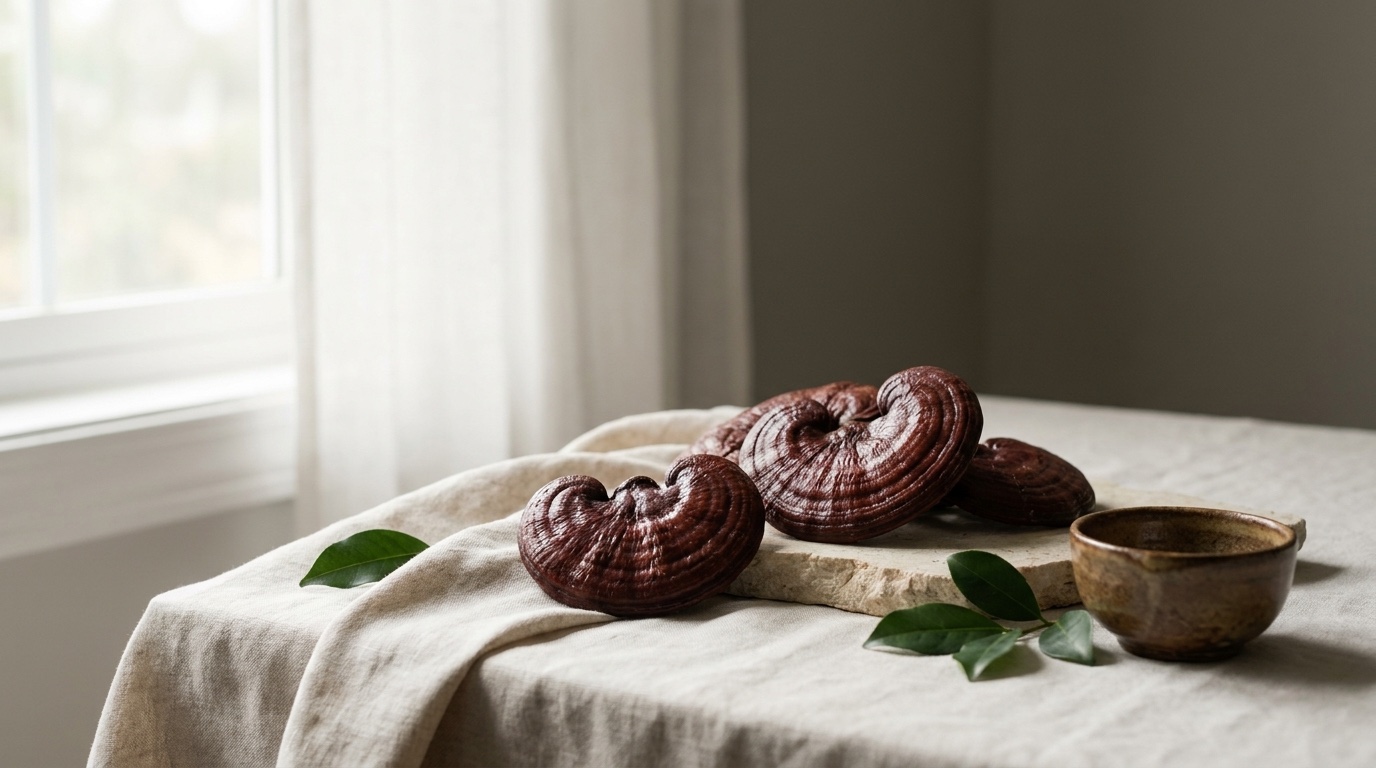
Reishi is the woody, fan-shaped fruiting body of the fungus — the part that's been used for two thousand years. But it's slow and expensive to grow. So a large share of cheaper supplements use something else entirely: mycelium (the root-like network) grown on a bed of grain like rice or oats, then dried and milled together with the grain it grew on. The industry term is "mycelium on grain" (MOG).
Why does this matter? Because the active compounds — the β-glucans — live mostly in the fruiting body, while grain is mostly starch. And starch is a glucan too (an alpha-glucan), so a lazy "polysaccharides" number on a label can look impressive while being almost entirely grain filler.
This has been quantified. A 2016 method paper in the Journal of AOAC International validated the analytical technique that separately measures β-glucan (the active fungal compound) from α-glucan (starch), precisely because the two were being conflated in mushroom products.1 Using that method, independent testing of commercial products found mycelium-on-grain supplements running as high as 66% α-glucan (starch) with only ~3% β-glucan — and, in one striking example, a product sold as "100% organic Ganoderma lucidum" measured 45% starch and just 7% β-glucan.2 By contrast, research consistently finds that genuine fungal fruiting-body tissue is where β-glucans concentrate.3
What to look for: the label should say "fruiting body" explicitly. Be wary of "mycelium," "mycelial biomass," "myceliated grain/rice," or vague "full-spectrum" wording — and treat a bare "polysaccharides X mg" figure with suspicion, because that number can be mostly starch.
2. Was it dual-extracted? (The chemistry says it has to be)
Reishi has two distinct families of active compounds, and — this is the key point — they don't dissolve in the same thing.
The foundational scientific reference on reishi spells out both extraction routes. The polysaccharides (β-glucans) are obtained "by extraction with hot water followed by precipitation with ethanol," while the triterpenes (ganoderic acids) are extracted "by means of methanol, ethanol, acetone, chloroform... or a mixture of these solvents."4 In other words: the β-glucans are water-soluble; the bitter triterpenes are alcohol-soluble.
This has a direct consequence for what you buy:
- A water-only reishi tea or hot-water extract captures the β-glucans but leaves much of the triterpene fraction behind.
- An alcohol-only tincture pulls the triterpenes but under-extracts the β-glucans.
- A dual extraction — hot water and alcohol, then recombined — is the only process that delivers both compound classes in one product.
This is the actual scientific reason a serious reishi product is dual-extracted. It's not a marketing flourish; it's a solubility problem with one correct solution.
3. β-Glucan content — the one number that matters
If you take away a single habit from this article, make it this: look for a tested β-glucan percentage, not a "polysaccharide" figure.
The published standard (the McCleary method, commercialised as the widely used Megazyme assay) works by measuring total glucan and alpha-glucan separately, then calculating β-glucan = total glucan − α-glucan.15 That subtraction is the whole game: it strips out the starch and tells you how much actual active fungal compound is present. A label that brags about "polysaccharides" without separating out β-glucan is, intentionally or not, hiding the starch.
What to look for: a stated β-glucan percentage (ideally backed by a Certificate of Analysis). Reputable fruiting-body extracts publish this. If a brand won't tell you their β-glucan number, that silence is itself an answer.
4. What species is it, really?
Here's a subtlety almost no consumer knows. The reishi traditionally used as medicine in East Asia is not the same fungus as the European Ganoderma lucidum it was long lumped together with. In 2012, mycologists used multi-gene DNA analysis to formally separate the cultivated East Asian "lingzhi" into its own species: Ganoderma lingzhi.6
The real-world consequence showed up when researchers DNA-barcoded supplements off the shelf. A 2020 study in PLOS ONE sequenced seven commercial reishi products all labelled "Ganoderma lucidum" — and found that all seven actually contained G. lingzhi DNA.7 To be fair and accurate: that's a naming mismatch rather than fraud (the products contained the genuine medicinal reishi, just under an outdated botanical name). But it tells you two important things: (1) the species on your label may not be precisely what's in the bottle, and (2) inexpensive DNA tools now exist to verify reishi identity — which a quality-focused brand can use, and a commodity one won't bother with.78 (The exact taxonomy is still debated among specialists, so anyone claiming total certainty here is overselling.6)
5. Where was it grown? (Reishi is a sponge for its environment)
Reishi doesn't just passively sit in its substrate — it actively pulls compounds out of it, including the bad ones. A 1999 study in Mycoscience showed cultivated G. lucidum takes up and tolerates substrate heavy metals including lead, cadmium and mercury.9 Because the mushroom bioaccumulates whatever its growing medium contains, the cleanliness of the substrate, soil and water is part of the product.
This isn't cause for panic — surveys of marketed medicinal mushrooms generally find heavy-metal levels within tolerable limits, and a 2025 risk assessment of a high-reishi-consuming population judged overall exposure low.1011 But the levels are quantifiable and variable, which is the point: anonymous bulk reishi (much of the global supply is commodity material of unstated origin) gives you no way to know what soil it grew in. Verifiable single-origin sourcing — a known farm, a known environment, third-party metal testing — is the only real answer to a bioaccumulator. It's why we can tell you exactly where ours comes from. Most brands can't, because they genuinely don't know.
For the deeper reader: triterpene fingerprinting
Quality also varies in the triterpene fraction — the ganoderic acids behind reishi's bitterness and much of its non-immune activity. Analytical chemists now use HPLC "fingerprints" of specific marker compounds (ganoderic acid B, lucidenic acid A and others) to grade reishi quality and tell species apart.12 One validated method found total triterpenes significantly higher in wild than in cultivated samples,13 and chromatographic fingerprinting is increasingly used for quality control of reishi raw material.14 You won't run an HPLC at home — but it's worth knowing that "how bitter and resinous is this reishi" is a real, measurable quality axis, not a romantic notion.
The 60-second reishi label checklist
Before you buy, check for:
- ✅ "Fruiting body" stated explicitly (not "mycelium," "myceliated grain," or vague "full spectrum")
- ✅ A tested β-glucan % — not just a "polysaccharides" number
- ✅ Dual-extracted (hot water and alcohol) so you get both β-glucans and triterpenes
- ✅ Known origin and third-party heavy-metal testing (reishi bioaccumulates)
- ✅ A brand that will show you a Certificate of Analysis on request
- 🚩 Red flags: a big "polysaccharides" number with no β-glucan figure; no mention of fruiting body; no origin; "proprietary blend" hiding the dose
Why we built Phangan Reishi the way we did
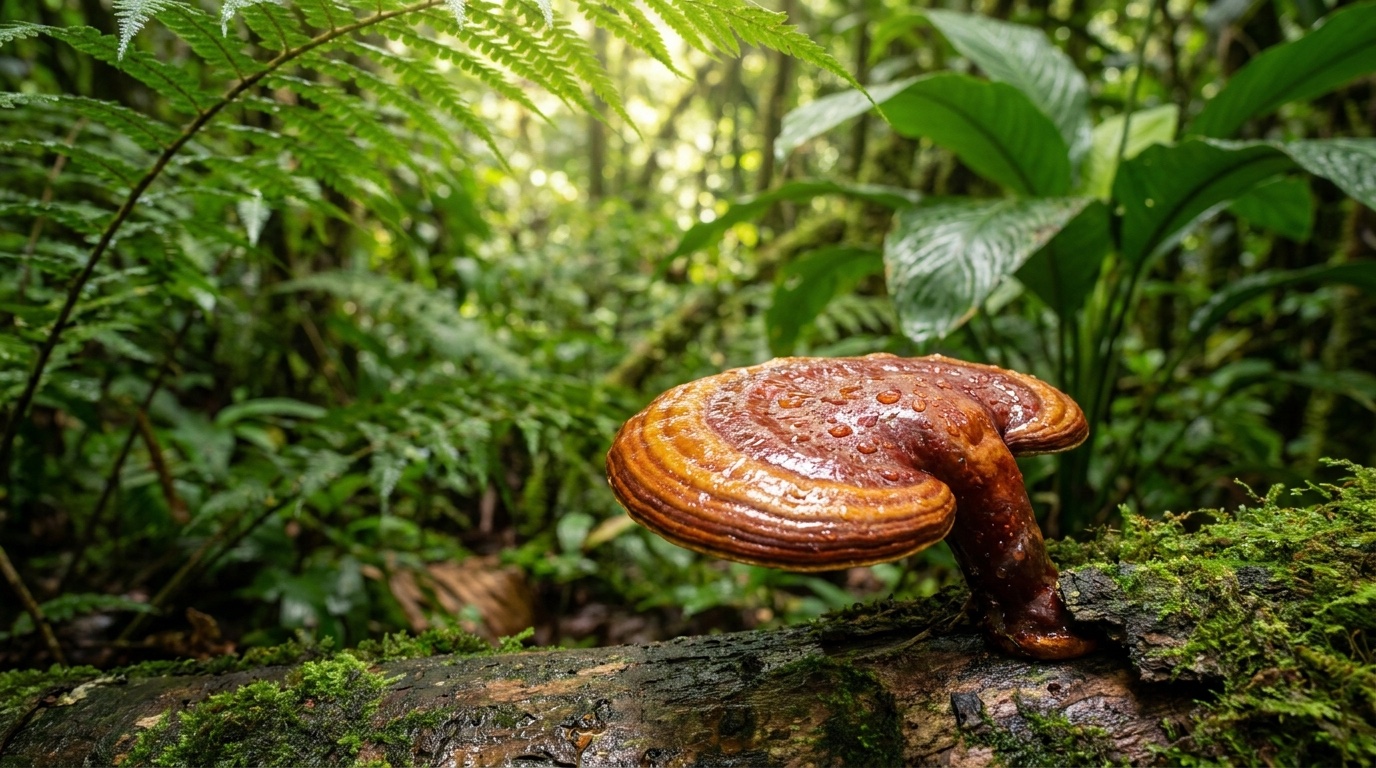
Every point above is a decision we made the harder, more expensive way. Phangan Reishi is whole fruiting body, dual-extracted so the cup carries both the β-glucans and the triterpenes, and grown at a single, named source — a small operation in the rainforest of Koh Phangan — rather than blended from anonymous commodity reishi of unknown origin. Your reishi has a postcode. Most reishi doesn't.
If you want the broader picture of what reishi can and can't do, start with our evidence-graded overview: Reishi Mushroom Benefits: What the Science Actually Says.
These statements have not been evaluated by the Food and Drug Administration. This product is not intended to diagnose, treat, cure, or prevent any disease. This article is for educational purposes and is not medical advice.
References
-
McCleary BV, Draga A. Measurement of β-glucan in mushrooms and mycelial products. Journal of AOAC International. 2016;99(2):364–373. PMID: 26957216. doi:10.5740/jaoacint.15-0289 — Validated analytical method separating β-glucan from α-glucan (starch). ↩ ↩2
-
Chilton J (NAMMEX). Redefining Medicinal Mushrooms (industry white paper; analytical data per McCleary method), ~2015–2016. Industry source, not peer-reviewed; per-product β-glucan/α-glucan figures cited illustratively. nammex.com/redefining-medicinal-mushrooms ↩
-
Sari M, Prange A, Lelley JI, Hambitzer R. Screening of beta-glucan contents in commercially cultivated and wild growing mushrooms. Food Chemistry. 2017;216:45–51. PMID: 27596390. doi:10.1016/j.foodchem.2016.08.010 — β-glucan concentrates in genuine fruiting-body tissue. ↩
-
Wachtel-Galor S, Yuen J, Buswell JA, Benzie IFF. Ganoderma lucidum (Lingzhi or Reishi): A Medicinal Mushroom. In: Herbal Medicine: Biomolecular and Clinical Aspects. 2nd ed. CRC Press/Taylor & Francis; 2011. Ch. 9. PMID: 22593926. NCBI Bookshelf NBK92757 — Documents hot-water extraction for polysaccharides and solvent extraction for triterpenes. ↩
-
Megazyme (Neogen). β-Glucan Assay Kit (Yeast & Mushroom), K-YBGL — manufacturer methodology based on McCleary & Draga (2016). Industry standard assay; β-glucan derived as total glucan minus α-glucan. ↩
-
Cao Y, Wu SH, Dai YC. Species clarification of the prize medicinal Ganoderma mushroom "Lingzhi". Fungal Diversity. 2012;56:49–62. doi:10.1007/s13225-012-0178-5 — Reclassifies cultivated East Asian reishi as the distinct species G. lingzhi. (Taxonomy still debated.) ↩ ↩2
-
Gunnels T, Creswell M, McFerrin J, Whittall JB. The ITS region provides a reliable DNA barcode for identifying reishi/lingzhi (Ganoderma) from herbal supplements. PLOS ONE. 2020;15(11):e0236774. PMID: 33180770. doi:10.1371/journal.pone.0236774 — 7/7 commercial "G. lucidum" supplements contained G. lingzhi DNA. ↩ ↩2
-
Liao B, Chen X, Han J, et al. Identification of commercial Ganoderma (Lingzhi) species by ITS2 sequences. Chinese Medicine. 2015;10:22. PMID: 26300957. doi:10.1186/s13020-015-0056-7 — DNA authentication of 33 commercial Ganoderma products. ↩
-
Tham LX, Matsuhashi S, Kume T. Responses of Ganoderma lucidum to heavy metals. Mycoscience. 1999;40:209–213. doi:10.1007/BF02464301 — G. lucidum takes up and tolerates substrate lead, cadmium, mercury and other metals. ↩
-
An JM, Gu SY, Kim DJ, et al. Arsenic, cadmium, lead, and mercury contents of mushroom species in Korea and associated health risk. International Journal of Food Properties. 2020;23(1):992–998. doi:10.1080/10942912.2020.1770786 — Quantifiable heavy-metal loads in marketed mushrooms incl. reishi; estimated exposure within tolerable limits. ↩
-
Lou D, Li Q, Ji L, et al. Risk assessment of potentially toxic elements exposure through Ganoderma lucidum consumption in the population of Longquan, China. Environmental Geochemistry and Health. 2025;47(11). PMID: 41128944. doi:10.1007/s10653-025-02828-8 — Overall risk judged low; Cr and As flagged for monitoring. ↩
-
Wu L, Liang W, Chen W, et al. Screening and analysis of the marker components in Ganoderma lucidum by HPLC and HPLC-MSn with the aid of chemometrics. Molecules. 2017;22(4):584. PMID: 28383512. doi:10.3390/molecules22040584 — Five triterpenoid acids established as quality-marker compounds. ↩
-
Ha DT, et al. An improved HPLC-DAD method for quantitative comparisons of triterpenes in Ganoderma lucidum and its five related species from Vietnam. Molecules. 2015;20(1):1059–1077. PMID: 25584835. doi:10.3390/molecules20011059 — Total triterpenes significantly higher in wild than cultivated reishi. ↩
-
Ding P, et al. Chromatographic fingerprints of triterpenoid constituents of Ganoderma lucidum. Zhongguo Zhong Yao Za Zhi. 2009. PMID: 20030088 — RP-HPLC fingerprint for reishi quality control. ↩